TCB Infotech | Expert Odoo & ERPNext Implementation Partner
Schedule Call With Us

Manufacturing ERP: Take Control of Your Production, Inventory, and Quality

If you run a manufacturing operation in India, you know the daily reality: raw material prices shifting without warning, production schedules that change by the hour, inventory counts that never match, quality issues caught too late, and GST compliance requirements that keep getting stricter. You’re managing all of this across spreadsheets, WhatsApp groups, and systems that don’t talk to each other. It works until it doesn’t. And when it stops working, it usually happens all at once: a missed delivery, a customer lost, a compliance penalty, or a production stoppage that could have been avoided with better visibility.

At TCB Infotech, we help manufacturers replace this chaos with connected, intelligent systems. We implement Odoo and ERPNext to give factories real-time control over production planning, inventory, quality, maintenance, shop floor operations, and financial management. Not generic software installations. Custom ERP setups designed around how your factory actually operates.

Book Free Manufacturing Assessment

What Manufacturing ERP Actually Solves

Let’s cut through the jargon. Here’s what a properly implemented manufacturing ERP does for your business:

You stop guessing inventory levels

Real-time stock tracking across warehouses replaces manual counts and Excel sheets. You know exactly what you have, where it is, and when you need to reorder. Automated replenishment rules trigger purchase orders before you run out, not after.

Production planning becomes predictable

Your MRP scheduler looks at sales orders, current stock, lead times, and capacity constraints to tell you exactly what to produce, when to produce it, and what materials to procure. No more “I think we have enough” conversations.

Quality issues get caught inline, not after shipping

Quality checks happen during receiving, during production, and before dispatch. When something fails, the system creates an alert, quarantines affected products, and tracks corrective actions. You find out in minutes, not weeks.

Your shop floor connects to your office

Operators on the factory floor log time, report consumption, flag issues, and complete work orders on tablets. Production managers see status in real time from their desk. No more walking to the floor to ask “where are we on that order?”

Costs stop being a mystery

Material costs, labour costs, and machine costs capture automatically as production happens. You know the actual cost of every product, every batch, every order. Variance reports show where planned costs differ from reality. GST input credits track automatically.

Everything connects to everything else

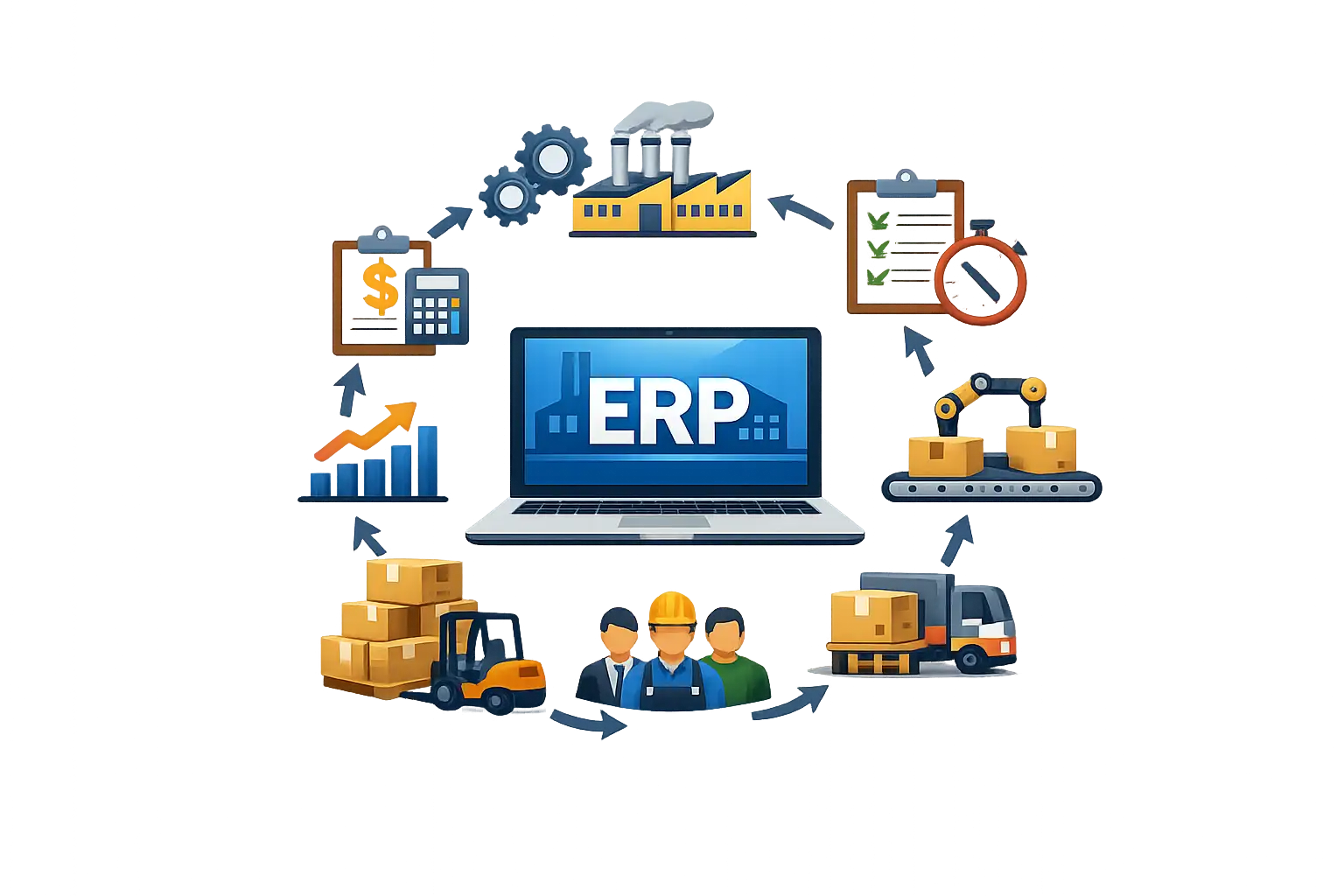
A sales order triggers production. Production triggers purchasing. Quality checks integrate with manufacturing. Finished goods update inventory. Delivery triggers invoicing. Invoicing flows to accounting. One system. One database. Zero manual handoffs.

⚠️

What Manufacturing ERP is NOT

Because expectations matter, here’s what ERP won’t do:

It won’t fix broken processes automatically. If your BOM is wrong, the ERP will faithfully plan with wrong data. We fix the processes first, then configure the software.
It’s not a magic button you press on Day 1. Proper implementation takes 3 to 9 months depending on complexity. Anyone promising “go-live in 2 weeks” for manufacturing is cutting corners you’ll pay for later.
It’s not one-size-fits-all. An auto parts manufacturer and a food processor have fundamentally different needs. Generic templates don’t work. Every implementation we do starts with understanding your specific production flow.
It won’t replace your people. It replaces the repetitive, manual, error-prone parts of their work so they can focus on decisions, improvements, and problem-solving.
We’re upfront about this because we’ve rescued projects where other vendors oversold what ERP can do. Setting the right expectations from the start is why we’ve never had a failed project.
Challenge
How We Solve It
Production delays from material shortages
MRP scheduler with automated purchase triggers based on BOM requirements and reorder levels
Inventory counts never match actual stock
Real-time barcode tracking, cycle counting during operations, automated stock valuation
No visibility into production costs until month-end
Real-time material + labour + machine cost capture flowing directly to accounting
Quality issues discovered after shipping
Inline quality checks at receiving, production, and dispatch with automated alerts
Subcontractor job work tracking in Excel
Subcontracting module tracking materials sent, processing time, and return with cost allocation
GST compliance is manual and error-prone
Automated GST computation, e-invoicing, GSTR reports, and TDS handling built into every transaction
Multiple disconnected systems (Tally + Excel + WhatsApp)
One integrated platform: sales, production, inventory, quality, purchasing, accounting
Equipment breakdowns causing unplanned downtime
Preventive maintenance scheduling, OEE dashboards, and IoT sensor integration for condition-based alerts
Engineering changes not reaching the shop floor
PLM with Engineering Change Orders, BOM versioning, and automatic update propagation to production

Manufacturing Sectors We Serve

We’ve implemented ERP for manufacturers across a range of sectors. Each one has specific requirements that generic ERP templates can’t handle. Here’s what we know from direct experience:

Auto Components & Engineering
Multi-level BOMs with 100+ components, serial number traceability for warranty and RMA, subcontracting for heat treatment and surface finishing, OEE tracking per machine, customer-specific part numbering, and packaging specifications.
Food & Beverage
Recipe-based BOMs with yield tracking, batch management with expiry dates, FSSAI compliance workflows, allergen tracking, temperature monitoring integration, and lot traceability from ingredient receipt to finished product dispatch.
Pharmaceuticals
GMP-compliant quality workflows, Drug License tracking, strict batch and lot traceability, environmental monitoring, controlled document management, deviation handling with CAPA tracking, and regulatory reporting.
Metal Fabrication & Machining
Configurable BOMs for custom orders, cutting and nesting optimisation, job work management for outsourced operations, multi-warehouse raw material tracking, and quotation-to-production workflows for engineer-to-order businesses.
Packaging & Printing
High-speed production tracking with barcode-driven shop floor, waste and scrap management, die/plate management, customer artwork version control, and automated replenishment for packaging consumables.
Electronics Assembly
Component-level serial tracking, revision-controlled BOMs through PLM, incoming material inspection with component verification, RMA and warranty tracking, and integration with pick-and-place machine data.
Textile & Garments
Size and colour variant management, fabric consumption tracking per style, multi-stage production with cut-sew-finish flow, subcontracting for embroidery and washing, and order-wise costing.

Our Platform Choices for Manufacturers

We don’t push a single platform. We recommend what fits your specific situation:

Odoo ERPNext
Best for Manufacturers needing e-commerce integration, advanced marketing, multi-entity operations, and visual customisation (Studio) Budget-conscious manufacturers wanting zero licensing costs, strong out-of-box manufacturing features, and simpler implementation
Manufacturing Modules MRP, BOM, Work Orders, Shop Floor, PLM, Quality, Maintenance, IoT, Subcontracting Manufacturing, BOM, Work Order, Quality Inspection, Production Plan, Maintenance
Indian Compliance GST, TDS, e-invoicing (Enterprise) GST, TDS, e-invoicing (built-in free)
Implementation Time 3 to 6 months typical for manufacturing 2 to 5 months typical for manufacturing
Our Track Record 50+ Odoo implementations across all industries ERPNext implementations with strong manufacturing focus

How We Implement Manufacturing ERP

Manufacturing implementations are more complex than service or distribution deployments. There are BOMs to structure, routings to define, quality checkpoints to configure, and a shop floor to onboard. We’ve developed a methodology specifically for factories:

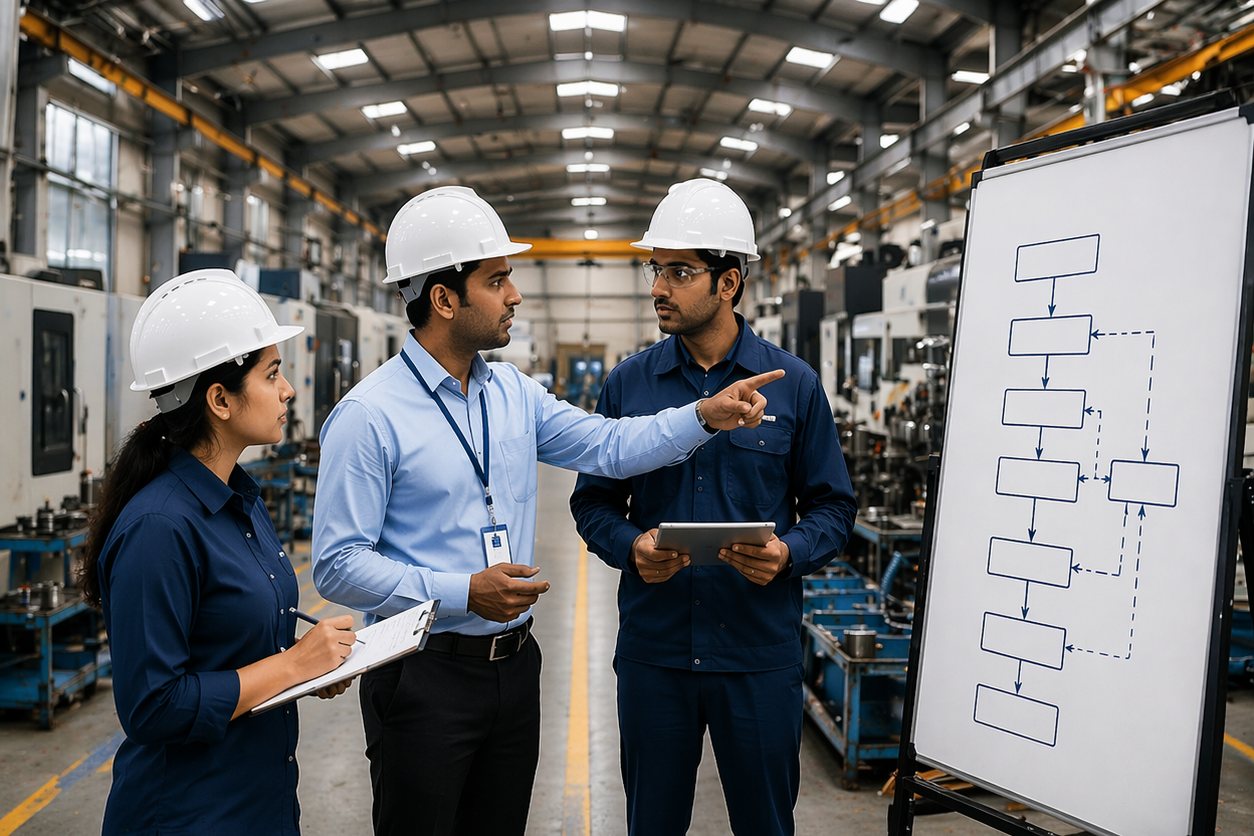
Step 1: Factory Walk & Process Mapping (Week 1 to 2)
We don’t start in a conference room. We start on your factory floor. We watch raw materials arrive, follow them through storage and staging, observe production operations, track quality checkpoints, and see how finished goods reach the warehouse. We document the real process, including the workarounds your team uses that aren’t in any SOP.
Factory walk
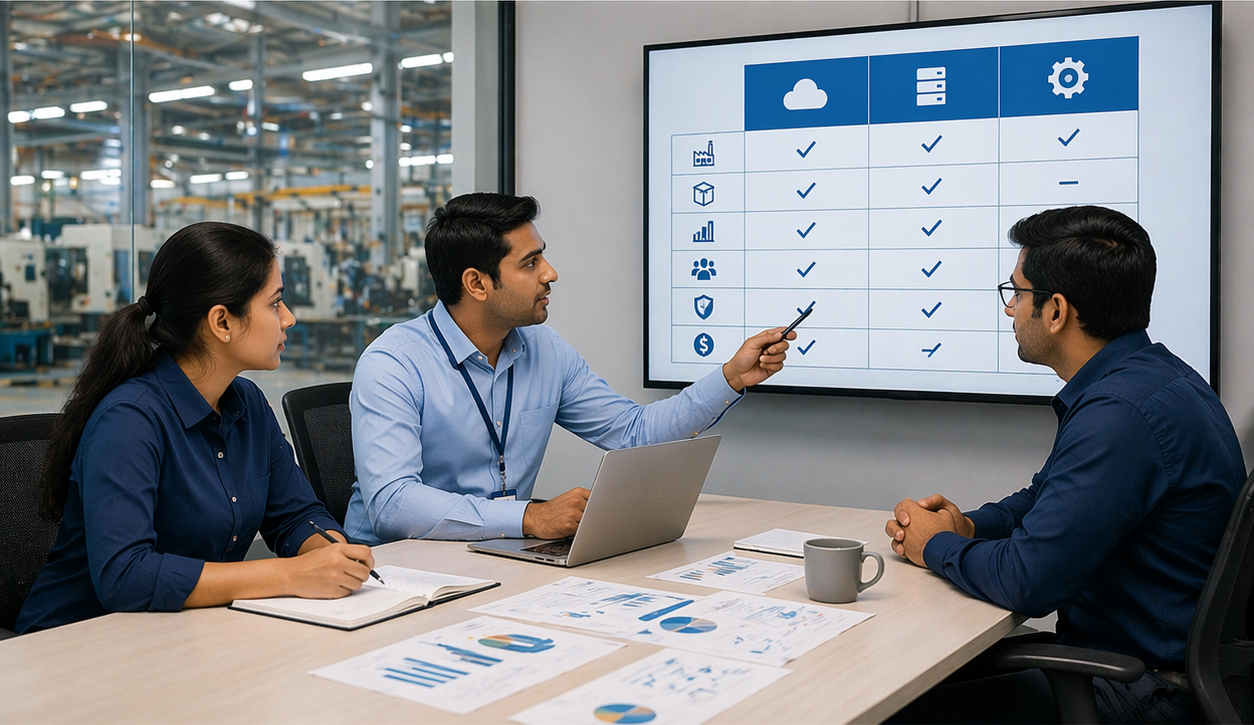
Step 2: Requirements & Platform Recommendation (Week 2 to 3)
Based on what we’ve seen, we recommend Odoo or ERPNext (or, in rare cases, a hybrid approach). We define which modules you need now and which can wait. We scope the BOMs, routings, quality workflows, and integrations. You get a detailed proposal with timeline, cost, and deliverables.
Planning
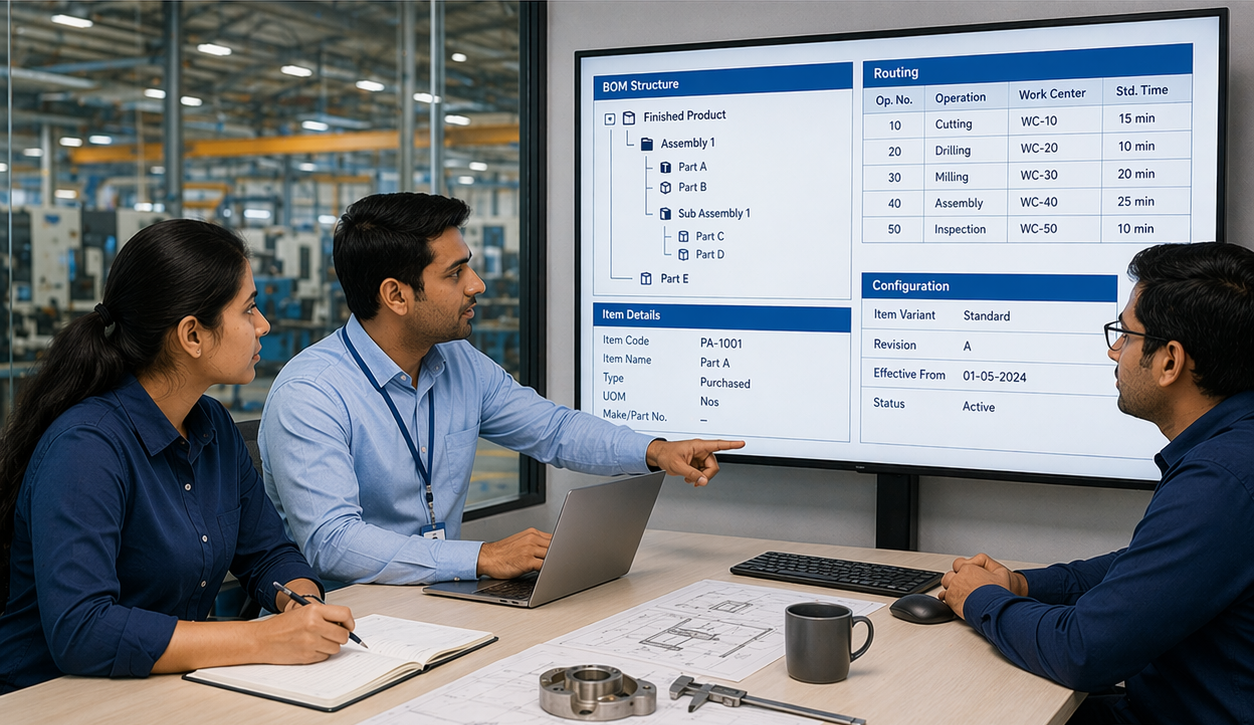
Step 3: BOM, Routing & Configuration (Week 4 to 10)
We build your product structures in the system. Multi-level BOMs, work centre definitions with capacity and cost rates, routing sequences, quality control plans, reorder rules, and warehouse configurations. This is where the system starts to mirror your factory.
System setup
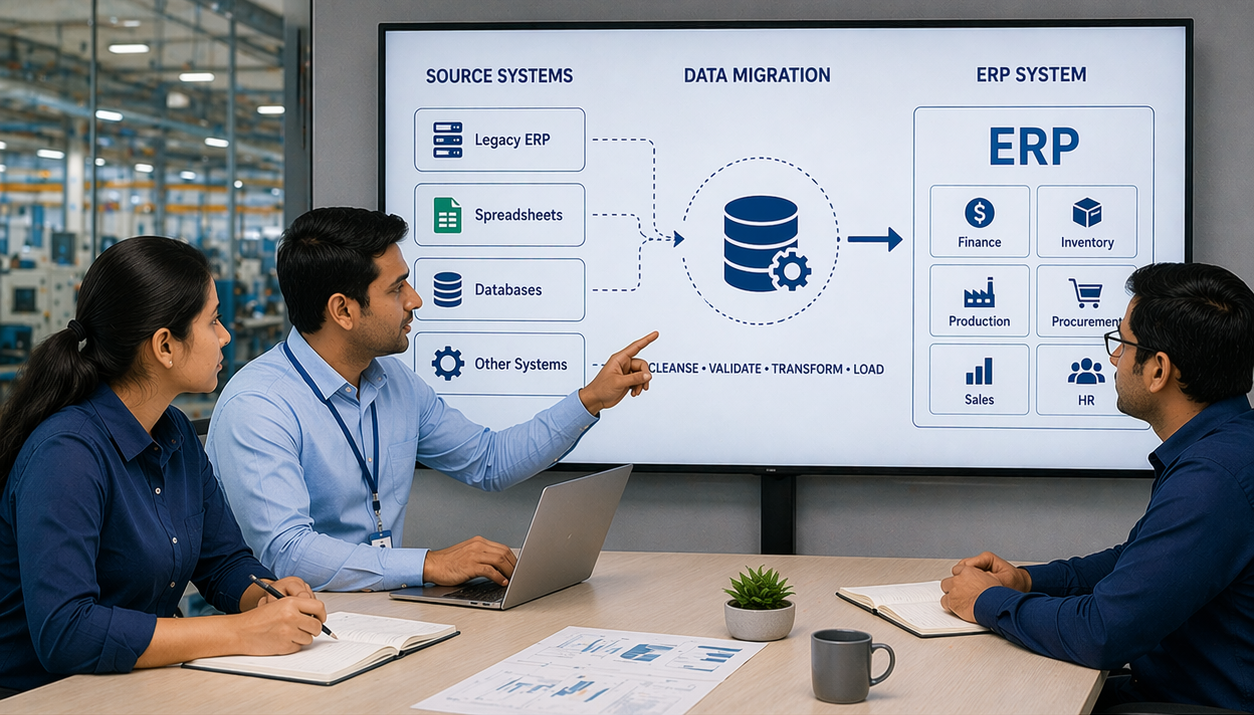
Step 4: Data Migration & Integration (Week 8 to 12)
We migrate your product master, customer and vendor records, opening inventory, and historical data from Tally, SAP, Excel, or whatever you’re currently using. We set up integrations with barcode scanners, weighing scales, label printers, and any third-party systems you need connected.
Data migration
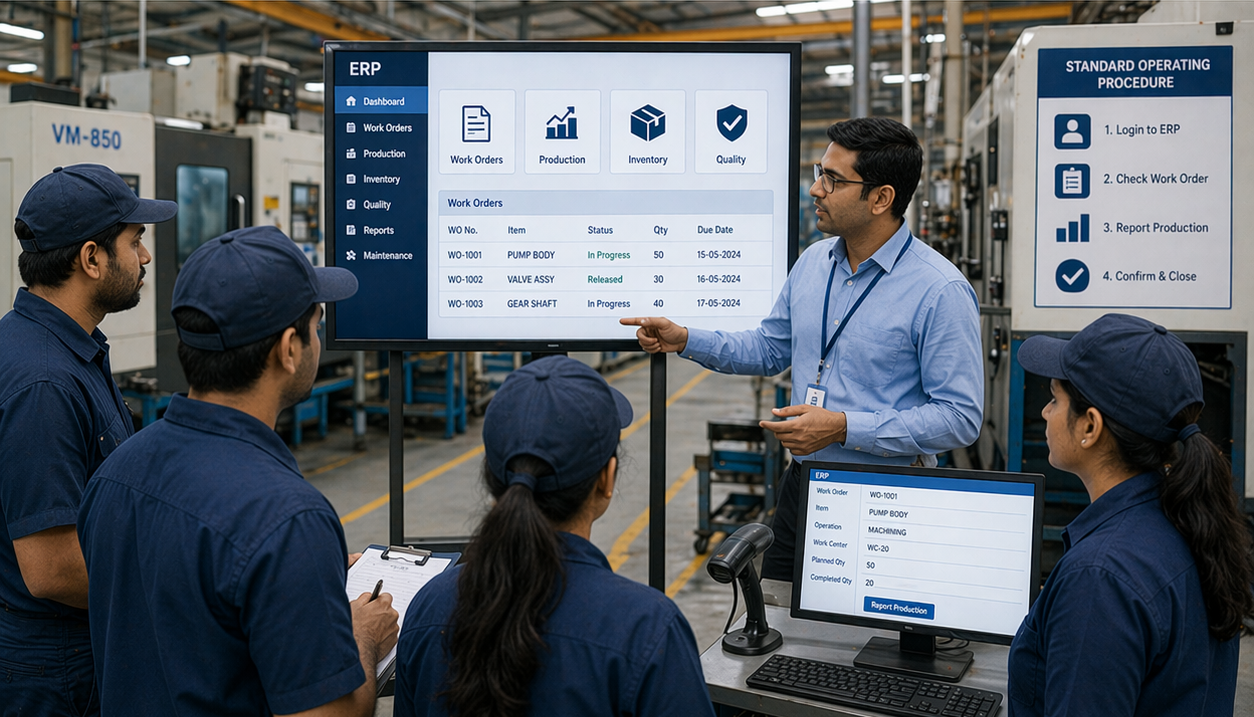
Step 5: Shop Floor Training (Week 10 to 14)
This is where most implementations either succeed or fail. We train your operators on the shop floor, using tablets, with their actual products and work orders. Not a PowerPoint in a meeting room. Hands-on training in the environment where they’ll use the system every day.
Training
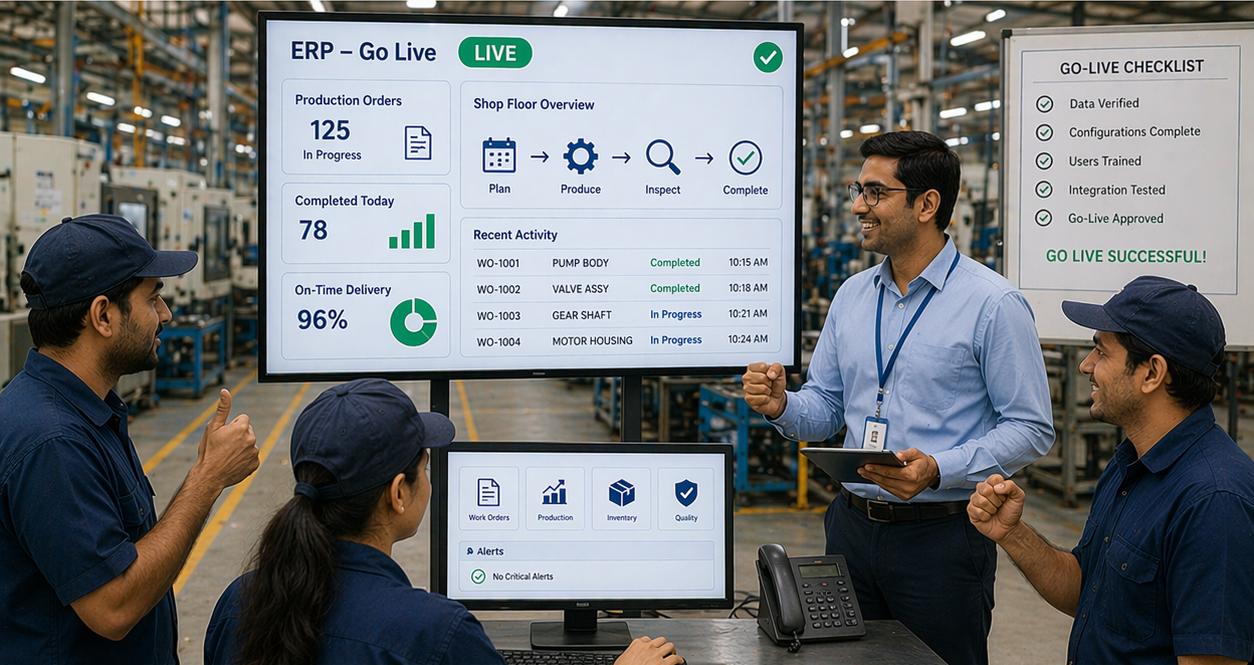
Step 6: Go-Live & Stabilisation (Week 12 to 18)
Phased go-live. We run parallel operations initially so nothing falls through the cracks. 15 to 60 days of complimentary post-go-live support. A team that answers the phone when something unexpected happens at 7am on production day.
Go live

AI-Powered Manufacturing

Beyond traditional ERP, we layer AI capabilities that give manufacturers a genuine competitive edge:

🤖

Predictive Demand Forecasting

Machine learning models trained on your historical sales data to predict demand patterns, seasonal variations, and trend shifts. Reduce stock-outs by 20 to 30%.

📄

Intelligent Document Extraction

Custom OCR pipelines for vendor invoices, challans, test certificates, and compliance documents. Eliminate manual data entry from paper-based supplier workflows.

💬

Natural Language Commands

Let your production manager type “show me all manufacturing orders delayed by more than 2 days” and get instant results. No filter building required.

👁️

AI Quality Inspection

Computer vision for visual defect detection on production lines (for clients with camera-equipped inspection stations).

⚙️

Smart Maintenance Alerts

IoT sensor data analysed by AI to predict equipment failures before they happen. Move from calendar-based maintenance to condition-based maintenance.

🌐

Hindi/English Chatbots

Self-service bots for shop floor operators to check production schedules, report issues, or request materials in their preferred language.

Results from Real Manufacturing Clients

Numbers from our actual implementations:

25 to 35%

reduction in production lead times within the first quarter

30%

decrease in production waste through better material tracking and consumption visibility

15 to 25%

improvement in inventory accuracy from real-time tracking replacing manual counts

10 to 15 hrs

per week saved in purchasing through automated PO generation

40%

faster quality non-conformance resolution through structured CAPA workflows

95%

on-time delivery rate achieved within 6 months (up from 70–75% pre-ERP)

One Operations Director at a manufacturing client told us: “TCB Infotech didn’t just implement software. They transformed how we operate. Production waste down 30%, inventory visibility across 3 warehouses, and automated purchasing saving 15 hours weekly. They understood our manufacturing challenges better than we did.”

Why TCB Infotech for Manufacturing

We’re not a generic IT services company that happens to do ERP. We specialise in it.

Manufacturing ERP
50+ successful ERP implementations

Zero failures. Since 2021.

Manufacturing Expertise

We’ve walked factory floors in Pune, Jaipur, Hisar, Dubai, and Oman.

Odoo + ERPNext

We recommend what fits, not what’s convenient for us.

35+ full-time professionals

100% team retention. The person who starts your project finishes it.

95% on-time delivery

If delays are caused by us, we absorb the cost.

AI-enhanced ERP

Capabilities that go beyond standard modules.

Rescue project specialists

If another vendor left you with a half-built system, we can fix it.

Post-go-live support

AMC packages, priority support, continuous optimisation.

Frequently Asked Questions

How long does manufacturing ERP implementation take?
For a typical 10 to 25 user manufacturing setup: 3 to 6 months. For larger operations with 50+ users, complex BOMs, and multiple locations: 6 to 9 months. We’ll give you a realistic timeline during our initial assessment.
How much does it cost?
Starter implementations (2 to 3 core modules, single location): ₹4 to 8 lakh. Professional implementations (5 to 8 modules, multi-location): ₹15 to 25 lakh. Enterprise implementations (10+ modules, multi-entity): ₹40 to 60 lakh. These include implementation, training, and post-go-live support. Licensing costs are separate (Odoo Enterprise) or zero (ERPNext/Odoo Community).
Can you migrate from our current system?
Yes. We’ve migrated manufacturers from Tally, SAP, Excel, custom software, and broken ERP implementations by other vendors. We handle product masters, BOMs, inventory, customer/vendor records, and historical financial data.
Do we need to shut down production during go-live?
No. We use phased go-live with parallel operations. Your factory keeps running while we transition module by module. We typically go live on a weekend or during a planned maintenance window for minimal disruption.
Odoo or ERPNext for our factory?
It depends on your specific needs, budget, and growth plans. Schedule a free assessment and we’ll give you an honest recommendation within the first conversation.

Running a factory on disconnected systems?

Let’s talk. We’ll walk through your production process and show you exactly how a connected ERP would handle it. No pitch deck. Just a conversation about your specific challenges

Book Free Manufacturing Assessment