TCB Infotech | Expert Odoo & ERPNext Implementation Partner

Schedule Call With Us

Retail & Wholesale ERP: Connect Every Store, Every Channel, and Every Transaction

Here is a number that should bother every retailer: Indian retail businesses lose an estimated 3 to 5% of revenue to inventory inaccuracy alone. That is not theft. That is not markdowns. That is stock that your system says you have but your shelves say you don’t, or stock you ordered twice because nobody could see what was already in transit. For a retailer doing ₹10 crore in annual revenue, that is ₹30 to 50 lakh disappearing into the gap between what your POS says and what your warehouse knows. Multiply that across 5 stores, add an online channel, and the number gets ugly fast. The root cause is always the same: disconnected systems. Your POS captures sales. Your accounting software (probably Tally) captures finances. Your inventory lives in Excel or in someone’s head. Your e-commerce platform has its own stock count. Your wholesale orders go through WhatsApp. Nothing talks to anything else, and the gaps between systems are where your money leaks.

At TCB Infotech, we connect these dots. We implement Odoo and ERPNext for retail and wholesale businesses so that POS, inventory, purchasing, e-commerce, customer management, and accounting operate as one system. Not five tools stitched together. One platform where a sale at Store 3 instantly updates stock across all stores, triggers a reorder if needed, posts to accounting, and updates the customer’s loyalty points. Automatically. In real time.

Book Free Retail Assessment

THE LIFE OF A PRODUCT (WITH ERP)

1
You decide to stock it
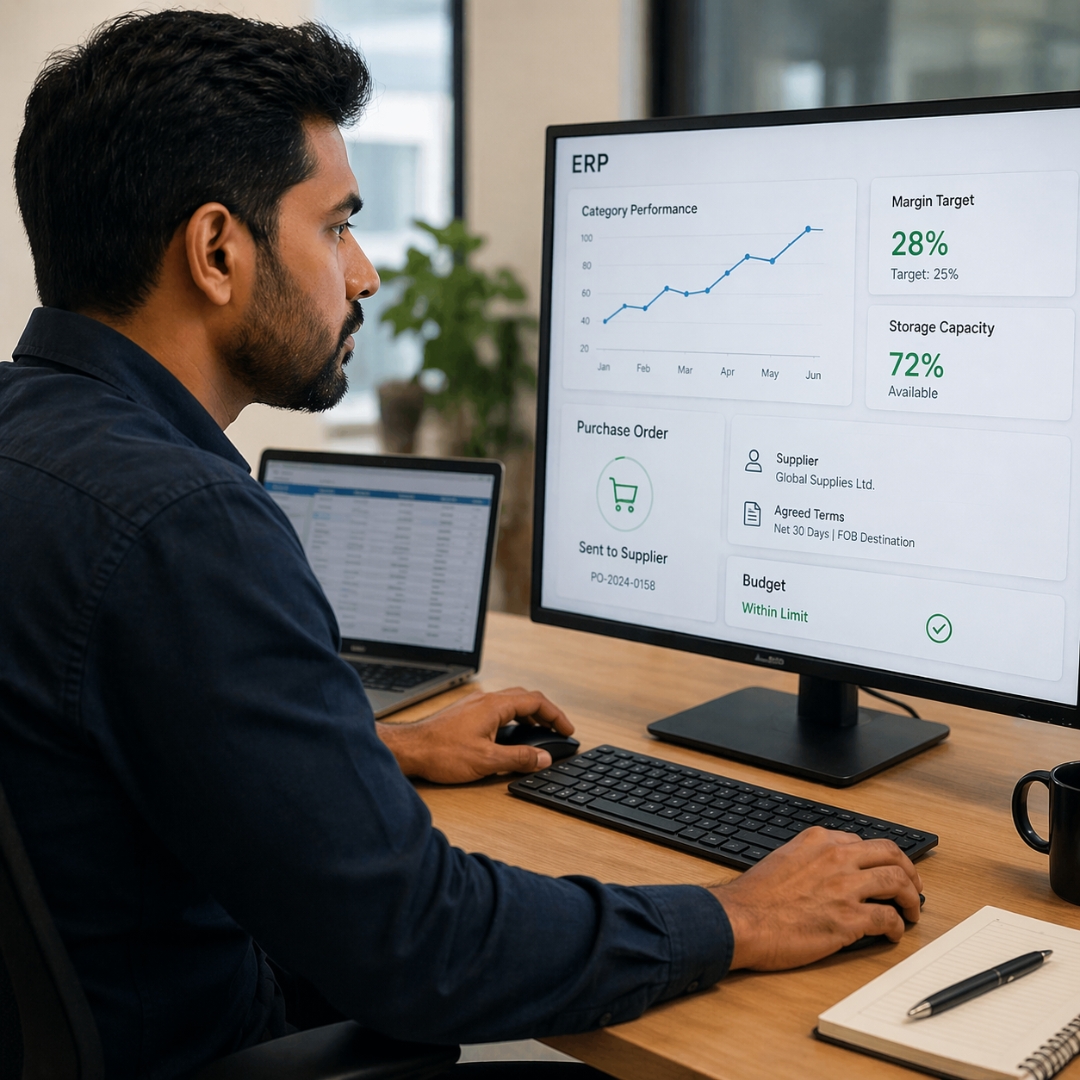
Your buyer spots a trending product. They check the ERP for current category performance, margin targets, and storage capacity across stores. A purchase order goes to the supplier with negotiated terms from the rate contract already in the system. The order links to a budget so procurement stays within limits.
2
It arrives at your warehouse
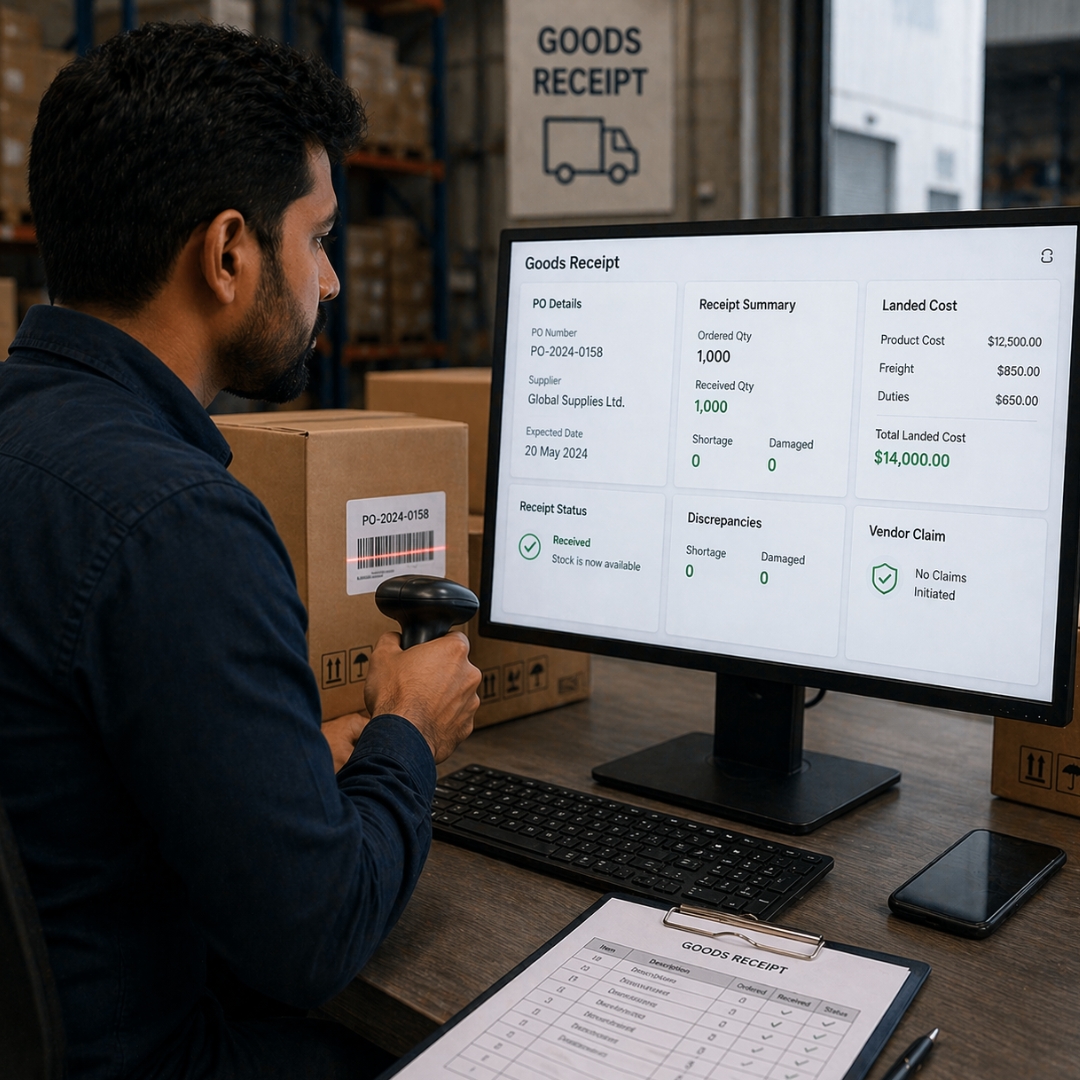
The goods receipt is logged with barcode scanning. Quantities are verified against the PO. Any shortages or damages get flagged immediately with photos and a vendor claim workflow starts. The stock is now visible in the system. Landed cost calculates automatically.
3
It moves to your stores
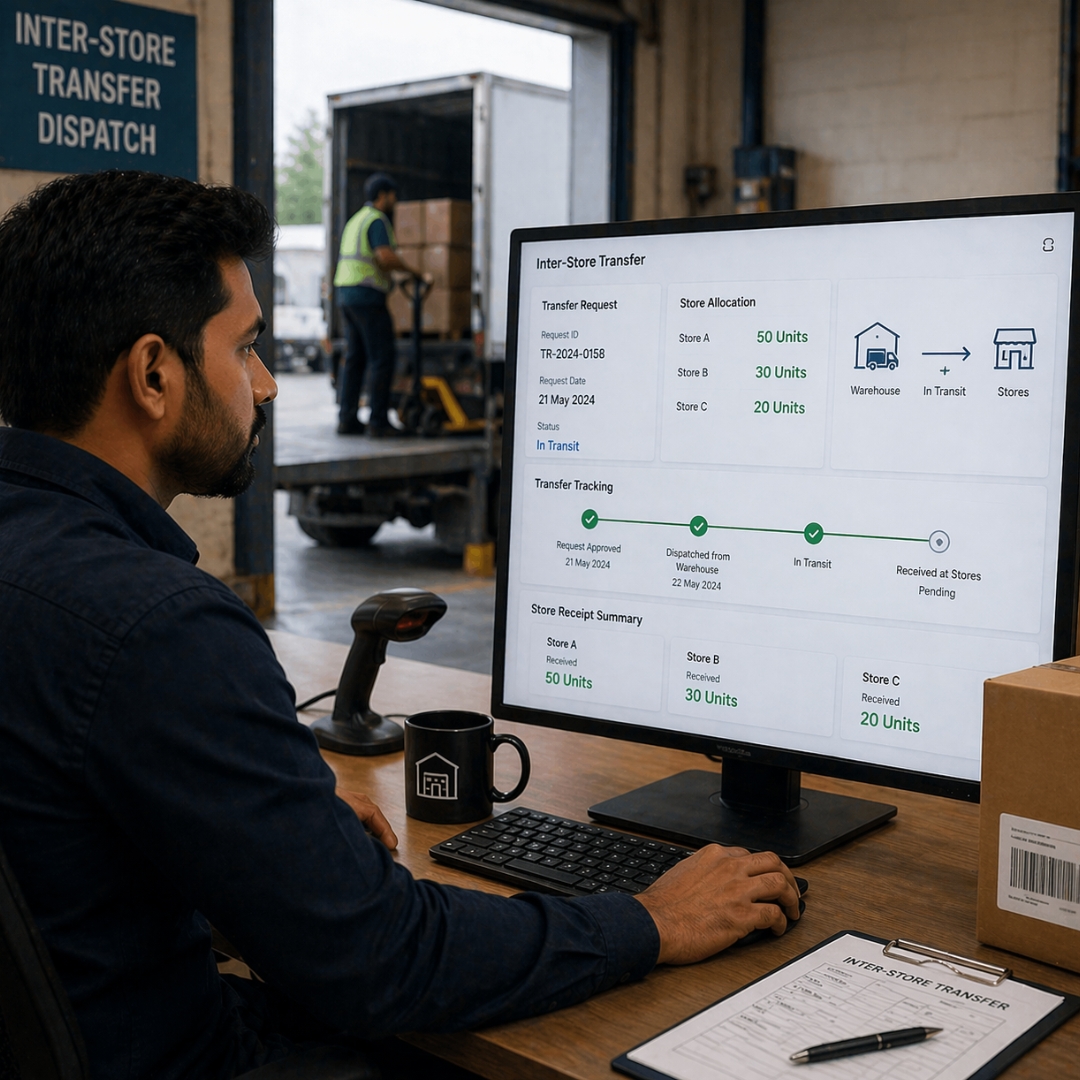
Inter-store transfer requests based on sales velocity. Each store receives stock and updates inventory through scanning.
4
A customer buys it in-store
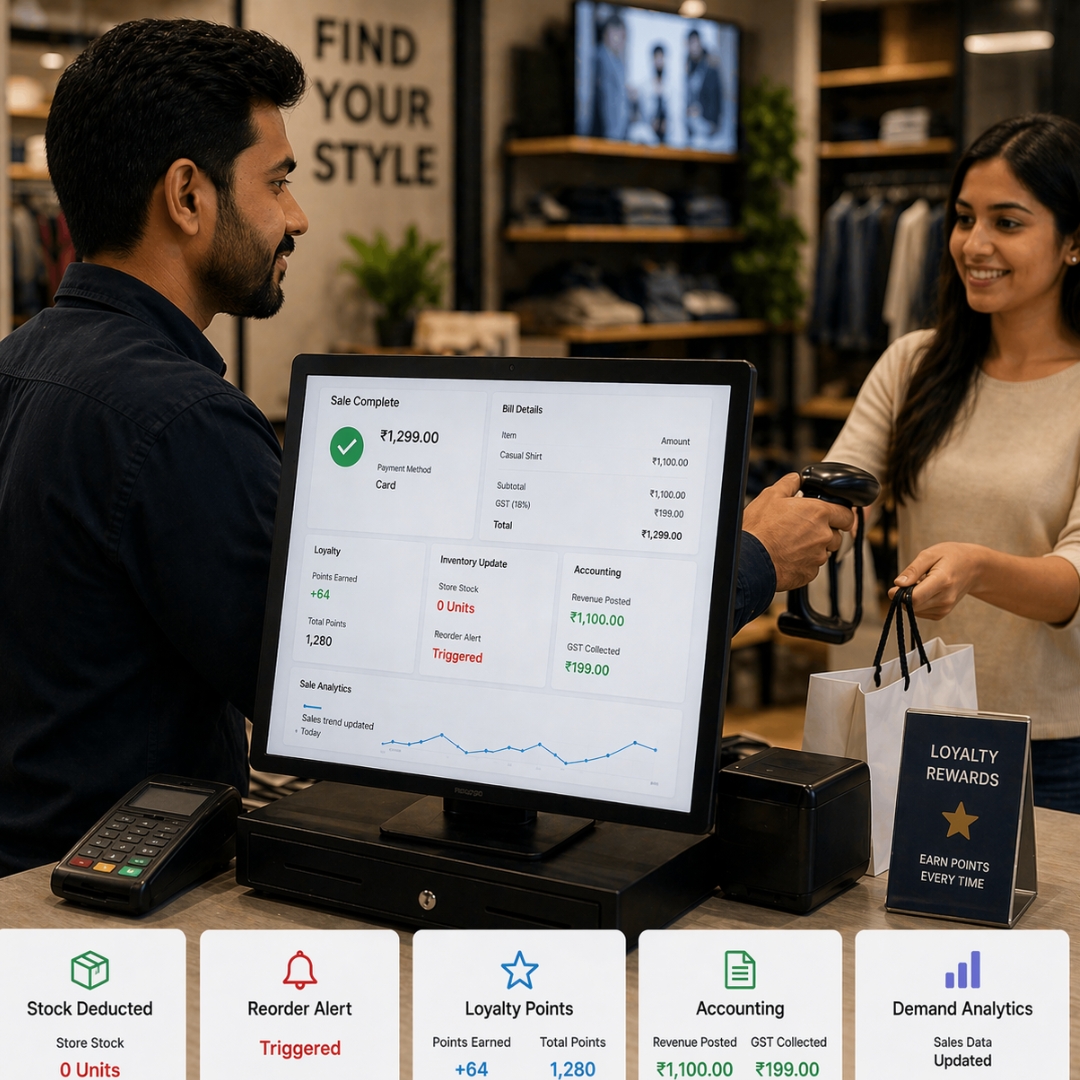
POS captures the sale. Stock deducts. Revenue posts to accounting. GST calculates. Loyalty points accrue. Reorder alerts trigger.
5
Another customer buys it online
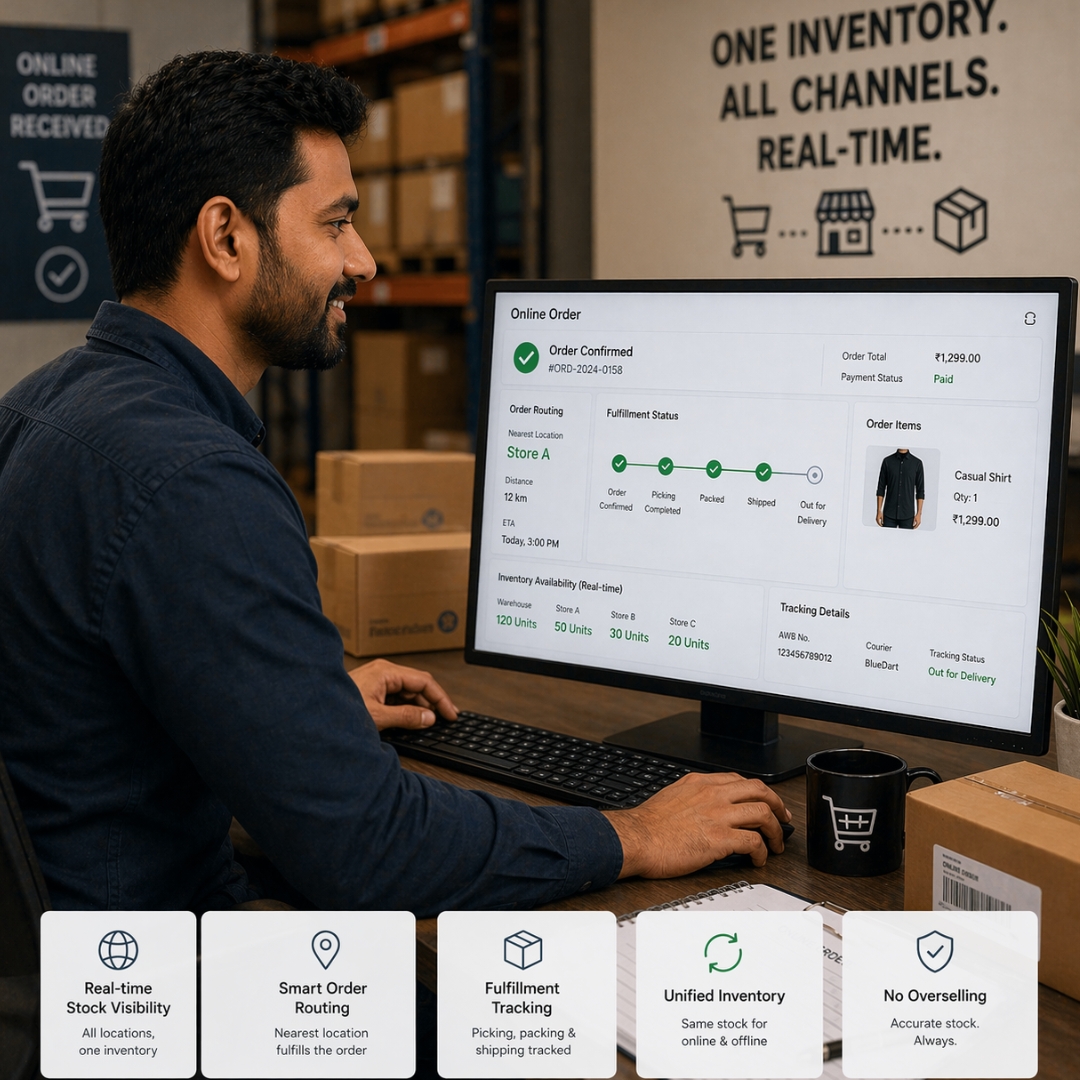
Real-time stock across all locations. Orders routed automatically. Unified inventory prevents overselling.
6
Someone returns it
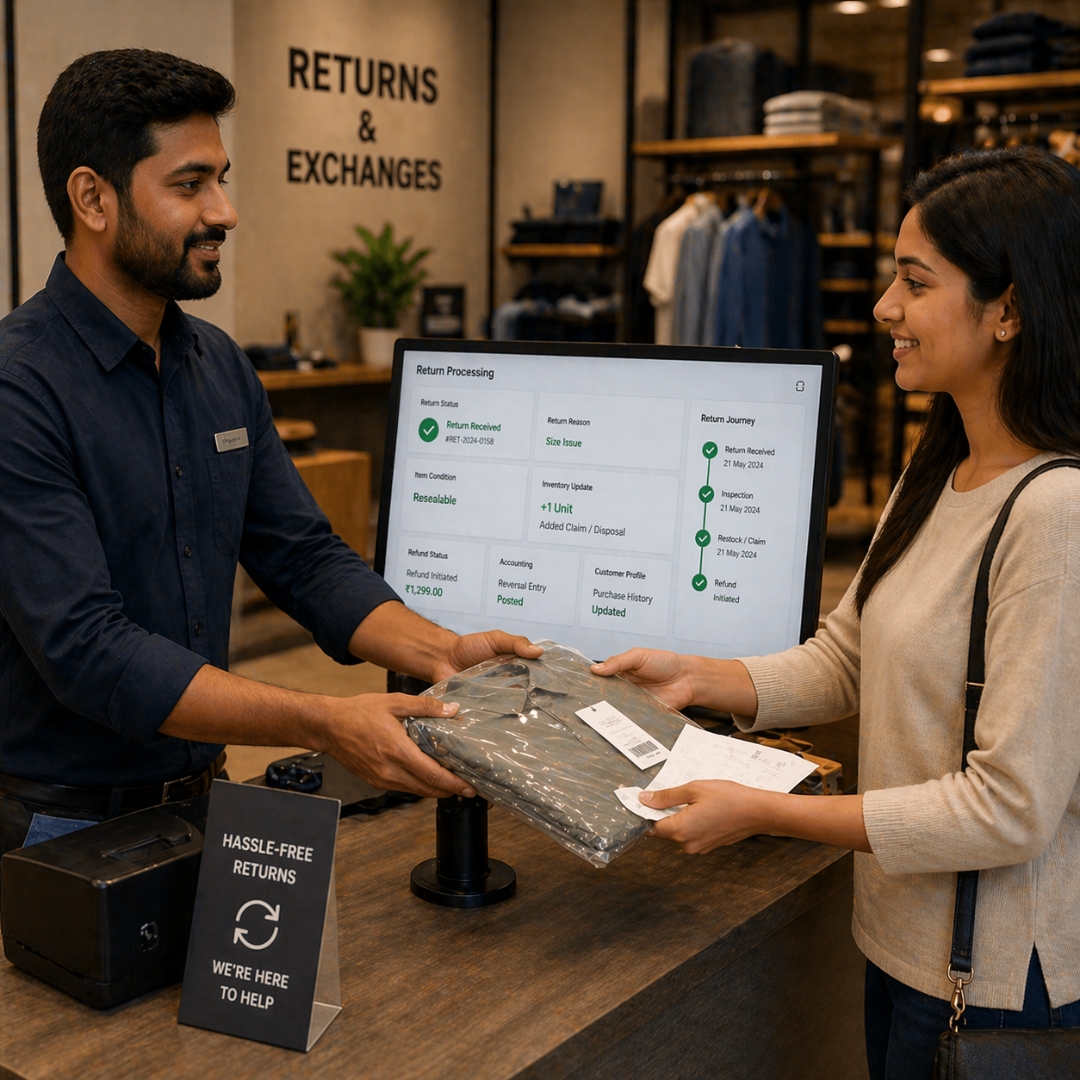
Returns processed with reason tracking. Inventory updated. Refunds and accounting reversed automatically.
7
You analyse what happened
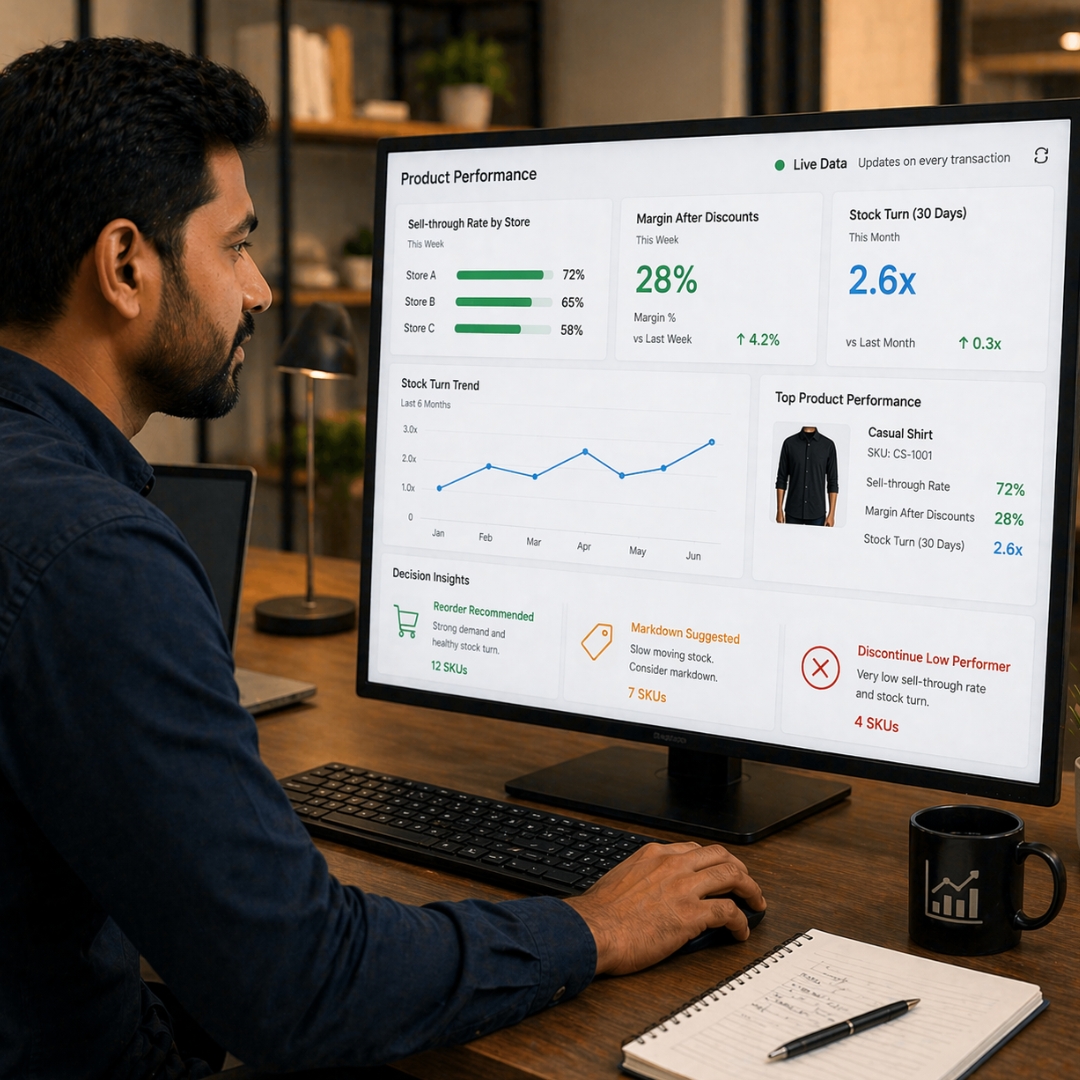
Real-time dashboards show sell-through, margins, and stock performance. Decisions are data-driven, not spreadsheet-based.

REAL SCENARIOS, REAL SOLUTIONS

Every retail and wholesale business is different. Here is how ERP works across the types of businesses we serve:

Fashion Retailer, 8 Stores + Online
Inventory tracked by store but not by size-colour combination. Best-selling sizes sell out while odd sizes pile up. Online returns create chaos because store staff cannot see original online orders. No consolidated view of which styles are profitable.
Odoo with size-colour-style variant matrix. Unified inventory across stores and e-commerce. POS integration at all outlets. Return processing linked to original order regardless of channel. Style-wise margin analysis including markdown impact. Loyalty programme across all channels.
Electronics Wholesale + Retail, 3 Showrooms + B2B
Wholesale customers get different pricing but it is managed in the salesperson’s head. Serial number tracking is manual. Warranty claims take weeks because nobody can find the original invoice. B2B orders and retail sales tracked in separate systems.
ERPNext with customer-specific pricelists for wholesale tiers. Serial number tracking from purchase to sale. Warranty tracking linked to serial and customer. Unified sales across retail POS and B2B orders. Automated GST invoicing for both B2C and B2B transactions.
Grocery Chain, 12 Outlets
Fast-moving perishables expiring on shelves. Different stores ordering independently, paying different prices for the same items. No central view of what is selling where. Manual billing at counters causing checkout queues.
Odoo POS with barcode scanning at all outlets. Centralised procurement with rate contracts. FEFO inventory for perishables. Automated reorder at outlet level based on sales velocity. Batch and expiry tracking. Consolidated purchasing to negotiate better rates. Real-time stock and sales dashboards per outlet.
Building Material Wholesaler, Single Location
Complex unit conversions (per piece, per kg, per bundle, per sqft). Customer credit limits managed in a notebook. Outstanding collections tracked in Excel. GST compliance is a monthly scramble.
ERPNext with multi-UOM product management. Customer credit limits with automatic order blocking. Ageing reports with automated payment reminders via WhatsApp. GST auto-computation with e-invoicing. Vendor rate contracts for cement, steel, and hardware suppliers. Margin analysis by product category and customer.

WHAT THE SYSTEM HANDLES

Point of Sale
Fast billing with barcode scanning. Touch-screen interface for cashiers. Multiple payment modes (cash, card, UPI, wallet). Split payments. Bill hold and recall. Discount and coupon management. Customer lookup and loyalty point redemption. Daily cash register closing with automated reconciliation. Offline capability so billing continues during internet outages.
Inventory Across Locations
Real-time stock visibility across all stores, warehouses, and online channels. Inter-store transfers with dispatch and receipt tracking. Automated reorder rules per location based on sales velocity. Barcode/QR scanning for receiving, transfers, and stock counts. Cycle counting during business hours without shutting down operations. Dead stock identification and markdown recommendations.
Purchasing and Vendor Management
Centralised procurement for chain operations. Vendor rate contracts with validity tracking. Comparative quotation analysis for new products. Purchase order generation from reorder rules. Three-way matching (PO vs receipt vs vendor invoice). Purchase return workflows. Vendor performance scoring based on delivery accuracy and quality.
Omnichannel Commerce
Connect your physical stores with your website, marketplaces (Amazon, Flipkart, Meesho), and social commerce. Single inventory pool serving all channels. Order routing to nearest fulfilment location. Click-and-collect workflows. Unified returns across channels. Consistent pricing or channel-specific pricing as needed.
Customer Management and Loyalty
Customer database across all touchpoints. Purchase history regardless of channel. Loyalty programme with point accumulation and redemption rules. Customer segmentation for targeted promotions. Birthday and anniversary automated offers. RFM (Recency, Frequency, Monetary) analysis identifying your most valuable customers and those at risk of churning.
Wholesale and B2B Operations
Customer-specific price lists and volume discounts. Credit limit management with automated blocking. Wholesale order management with partial delivery tracking. B2B portal for customer self-service ordering. Separate GST treatment for B2B (with e-invoicing) and B2C transactions. Dealer and channel partner management for brands selling through intermediaries.
Accounting and Compliance
Every POS transaction, purchase, and payment posts to accounting automatically. GST computation at correct rates (5%, 12%, 18%, 28% depending on product). E-invoicing for B2B transactions above threshold. TDS where applicable. Daily, weekly, and monthly financial closing. Store-wise and channel-wise P&L. Bank reconciliation with automated matching for high-volume retail transactions.

WHICH PLATFORM FITS YOUR RETAIL BUSINESS?

Instead of a generic comparison, here is a decision framework. Find the statement that matches your situation:

Your Situation Odoo ERPNext
I need a built-in POS for my stores Strong fit. Odoo POS is integrated, fast, and works offline. Basic POS exists but not as mature. Third-party POS integration is better.
I sell online + in-store (omnichannel) Strong fit. Odoo e-commerce + POS share one inventory pool. Possible with custom development but not out-of-box.
I run a wholesale-only trading business Works well with customer pricelists and credit management. Excellent fit. Zero licensing. Strong invoicing and inventory.
I am a fashion retailer with size/colour variants Odoo handles product variants well with matrix views. Variants supported but less visual. Custom work may be needed.
Budget is my primary concern Enterprise licensing adds cost per user. Strong fit. Zero licensing. You pay only for hosting and implementation.
I have 5+ stores to manage centrally Strong fit. Multi-location, centralised purchasing, consolidated reporting. Works but multi-outlet management needs more configuration.
I need marketing automation and loyalty Built-in email marketing, SMS, loyalty programmes. Basic CRM. Loyalty and marketing need custom development.
I handle B2B and B2C from the same system Handles both with separate pricing and invoicing rules. Handles both well. Strong B2B features with customer portals.

SMART CAPABILITIES

AI and automation features that make a real difference in retail and wholesale:

Demand Sensing
ML models predicting which products will sell in which store next week. Reduce stock-outs on bestsellers and overstock on slow movers simultaneously. Factor in seasonality, local events, and historical patterns.
Automated Replenishment
Go beyond static min/max rules. AI calculates optimal reorder quantities considering supplier lead times, storage capacity, cash flow, and demand trends. Different logic for each store based on its sales pattern.
Smart Pricing Suggestions
AI analysis of margin performance, competitive pricing, and sell-through rates to suggest optimal pricing and markdown timing. Identify products where a 5% price increase would not affect volume but would significantly improve margins.
Document Processing
OCR for vendor invoices, purchase orders, and delivery challans. Auto-match against POs. Eliminate manual data entry for businesses processing 50+ vendor invoices daily.
Customer Intelligence
Identify high-value customers trending toward churn. Predict which product categories a customer is likely to buy next based on purchase history. Automate personalised offers based on behaviour, not just demographics.

HOW WE GET YOU LIVE

Retail implementations move fast because the business cycle is daily. Here is our path:

1
Audit (Week 1 to 2)
We visit your stores, warehouse, and office. We observe billing, receiving, inter-store transfers, purchasing, returns, and daily closing. We count how many times someone opens Excel or WhatsApp to do something the ERP should handle.
2
Design (Week 2 to 4)
Platform selection (Odoo or ERPNext). Module mapping. Product master structure (categories, variants, barcodes). Pricing rules. Store and warehouse configuration. Integration points (e-commerce, payment gateways, marketplaces). You get a detailed proposal.
3
Build (Week 4 to 10)
Product master setup with barcodes and pricing. POS configuration per store. Inventory setup with bin locations and reorder rules. Purchasing workflows. Accounting integration with GST. Customer loyalty setup. E-commerce integration if applicable.
4
Data (Week 8 to 12)
Product catalogue migration. Opening stock with barcode mapping. Customer master with purchase history (for loyalty). Vendor master with rate contracts. Financial opening balances from Tally. Historical sales data for demand analytics baseline.
5
Train (Week 10 to 14)
POS training for cashiers (at the counter, with real products). Inventory training for store managers. Purchasing training for the buying team. Accounting training for the finance team. Dashboard training for management. Every session uses your actual data.
6
Launch (Week 12 to 16)
One pilot store first. Iron out issues in a controlled environment. Then roll out store by store over 2 to 4 weeks. 30 to 60 days post-go-live support. We are available when the POS has a hiccup during Saturday evening rush.

WHAT CHANGES

70–75% → 95%+
The number that matters most: Retail clients typically see inventory accuracy jump from 70 to 75% to 95%+ within the first quarter. That single improvement drives every other gain: fewer stock-outs, less dead stock, lower markdown losses, and better purchasing decisions.

Order processing from manual entry to scan-and-bill, reducing checkout time by 40 to 60%

Inter-store stock transfers tracked in real time instead of phone calls and Excel

Purchasing time reduced by 50% through automated reorder rules and vendor rate contract management

Daily financial closing automated instead of weekly or monthly manual reconciliation

Multi-store performance comparison dashboards available for the first time (revenue, margin, stock turn, staff productivity per store)

GST compliance automated: e-invoicing for B2B, correct rate application for mixed-category retail, GSTR report generation

Customer retention improved through data-driven loyalty programmes and personalised engagement

Why TCB Infotech for Retail & Wholesale

50+

ERP implementations with zero failures since 2021 across retail and wholesale operations.

Retail Expertise

We understand retail margins, seasonal demand spikes, multi-store operations, and the complexity of managing inventory across channels.

Platform Flexibility

We implement Odoo and ERPNext. We recommend what fits your business model, not what is easiest for us.

35+ Team

35+ full-time professionals with 100% team retention. The same team works with you from start to go-live.

India + GCC Experience

Experience across India, UAE, and Oman, handling both retail chains and wholesale distribution businesses.

Retail Reality Support

Your POS cannot go down during peak hours. We provide post-go-live support that stays and evolves as your stores, SKUs, and channels grow.

YOUR QUESTIONS, ANSWERED

Everything retailers and wholesalers typically ask before going live with ERP:

How long does implementation take?
Single store: 2 to 3 months. Multi-store chain (3 to 10 stores): 3 to 5 months. Wholesale operation: 3 to 4 months. Chain with omnichannel (stores + online): 4 to 7 months. We recommend going live at one pilot store first, then rolling out.
Can it integrate with my existing POS hardware?
Yes. Standard barcode scanners, receipt printers, cash drawers, and card machines work with both Odoo POS and ERPNext. If you have brand-specific POS hardware, we test compatibility during the design phase.
We sell on Amazon and Flipkart. Can orders sync?
Yes. Odoo integrates with major Indian marketplaces. ERPNext can integrate through custom connectors. Orders from marketplaces sync into the ERP, inventory deducts across all channels, and fulfilment tracks from picking to dispatch.
Can I see all my stores in one dashboard?
Yes. Store-wise sales, inventory levels, margin performance, staff metrics, and alerts all visible in real time. Drill down from consolidated view to individual store to individual transaction.
We do both wholesale (B2B) and retail (B2C). Can one system handle both?
Yes. Both Odoo and ERPNext support separate pricelists, payment terms, and invoicing rules for B2B and B2C customers. GST treatment differs automatically (e-invoicing for B2B, simplified invoicing for B2C). Credit limits apply for wholesale accounts.
Will my billing stop if the internet goes down?
With Odoo POS, no. It works offline and syncs when connectivity returns. For ERPNext, a local network setup ensures billing continues at individual stores even without internet. No retailer should lose sales because of a connectivity blip.

Running your retail or wholesale business on disconnected POS, Tally, and Excel?

Let us show you what connected operations look like. We will trace a product through your actual business and demonstrate where the gaps are and how they close.

Book Free Retail Assessment