
If you’ve been burned by expensive ERP implementations that promised transformation but delivered chaos, you’re not alone. ERPNext vs traditional ERP is a debate that’s reshaping how Indian SMEs approach enterprise software. Traditional ERP systems from SAP, Oracle, and Microsoft Dynamics have left countless mid-sized businesses frustrated with vendor lock-in, hidden costs, and rigid systems that don’t adapt to their unique needs.
The enterprise software landscape is changing rapidly. While legacy ERP vendors continue to push expensive, inflexible solutions, open-source alternatives like ERPNext are proving that Indian businesses don’t need to sacrifice functionality for affordability—or flexibility for power.
In this comprehensive guide, we’ll break down the real differences between ERPNext and traditional ERP systems, expose the hidden costs that vendors don’t advertise, and help you determine which solution genuinely fits your business—without the sales pitch.

The Traditional ERP Problem: Why Indian Businesses Are Making the Switch
Vendor Lock-In & Hidden Licensing Costs That Never End
When comparing ERPNext vs traditional ERP, the licensing model reveals a stark contrast. Traditional ERP vendors have perfected the art of trapping businesses in expensive, never-ending licensing agreements that drain resources year after year.
Here’s what most businesses don’t realize until it’s too late:
Per-User Licensing Nightmare:
- Base per-user fees starting at ₹50,000-₹1,50,000 annually
- Costs escalate by 3-5% every year automatically
- No flexibility to reduce licenses during slow periods
- Hidden “concurrent user” vs “named user” pricing tricks
Forced Upgrade Cycles:
- Mandatory upgrades every 3-5 years costing ₹25-40 lakh
- Legacy version support withdrawal forcing expensive migrations
- “Security updates” held hostage behind upgrade fees
- Breaking changes that require re-training and re-customization
Customization Ransom:
- Simple workflow changes: ₹5-10 lakh
- Custom reports: ₹2-5 lakh each
- Integration with third-party tools: ₹8-15 lakh
- Annual “maintenance” of customizations: 20% of development cost
Consultant Dependency:
- Daily rates of ₹15,000-₹25,000 for certified consultants
- Minimum engagement periods of 3-6 months
- Can’t make changes without vendor-certified partners
- Knowledge transfer that never actually happens
The harsh truth? You don’t own the system—you rent it forever. And unlike your office space, this rent only increases, never decreases, regardless of your business performance.
Rigid Systems That Force You to Change Your Business
Legacy ERP implementations follow a frustrating pattern: instead of the software adapting to your proven business processes, you’re forced to contort your operations to fit the vendor’s rigid framework.
Real examples from Indian SMEs:
- NBFC Loan Approval Workflows: Need a custom multi-stage approval process for different loan products? Traditional ERP vendors quote ₹8-12 lakh and 6-9 months for what should be a straightforward workflow configuration.
- Manufacturing BOM Variations: Managing multiple bill of materials for the same product with regional variations? Expect ₹5-8 lakh in customization fees and a system that breaks with every upgrade.
- GST Compliance Nuances: Handling complex GST scenarios with inter-state transfers, e-way bills, and reverse charge mechanisms? Traditional vendors charge premium fees for features that should be standard in Indian-focused ERP.
The ERPNext vs traditional ERP comparison becomes crystal clear when you need flexibility: one charges lakhs for basic customizations, the other gives you the freedom to modify as needed.
What Makes ERPNext Different? Open Source Means Open Possibilities
True Ownership: Your Data, Your System, Your Future
When evaluating ERPNext vs traditional ERP systems, ownership is the fundamental difference that changes everything.
With ERPNext, you genuinely own:
- The Source Code: Every line of code is accessible, auditable, and modifiable. No black boxes, no proprietary mysteries, no vendor secrets. You can review exactly how your business data is processed, stored, and secured.
- Your Business Data: No vendor can hold your data hostage. Export anytime, in any format. Migrate to another hosting provider without permission. Keep backups wherever you want. Your data belongs to you—period.
- Implementation Partner Freedom: Don’t like your current implementation partner? Switch without penalties. Get multiple quotes for the same work. Hire freelance developers for small changes. The community has hundreds of certified partners across India—you’re never stuck.
- Unlimited Customization Rights: Modify core modules, create custom apps, build industry-specific features—all without asking permission or paying licensing fees. The Frappe framework that powers ERPNext is designed for extensibility.

Unlimited Customization Without Premium Fees
This is where ERPNext vs traditional ERP comparison truly shines. Need a custom report? Build it yourself in hours using ERPNext’s Report Builder, or have a developer create it for ₹10,000-₹20,000 instead of ₹2-5 lakh.
Want to modify a workflow? ERPNext’s visual workflow builder lets non-technical users create complex approval processes without writing code. Compare this to SAP’s workflow customization that requires expensive ABAP developers.
Real Customization Examples:
- Custom Pricing Rules: Create industry-specific pricing logic—volume discounts, customer-tier pricing, seasonal adjustments—in days, not months. Traditional ERP vendors would charge ₹3-6 lakh for similar functionality.
- Industry-Specific Modules: The ERPNext community has built free apps for specific industries: healthcare, education, agriculture, real estate. Install them freely, modify them as needed, or use them as starting points for your custom requirements.
- Integration Flexibility: Connect ERPNext to payment gateways, logistics providers, GST APIs, banking systems, and e-commerce platforms using REST APIs. Traditional ERP vendors charge ₹5-10 lakh per integration.
- Multi-Company Consolidation: Manage multiple legal entities with consolidated reporting—a feature that costs additional licenses in traditional ERP but comes standard in ERPNext.
Cost Comparison: ERPNext vs SAP, Oracle & Microsoft Dynamics
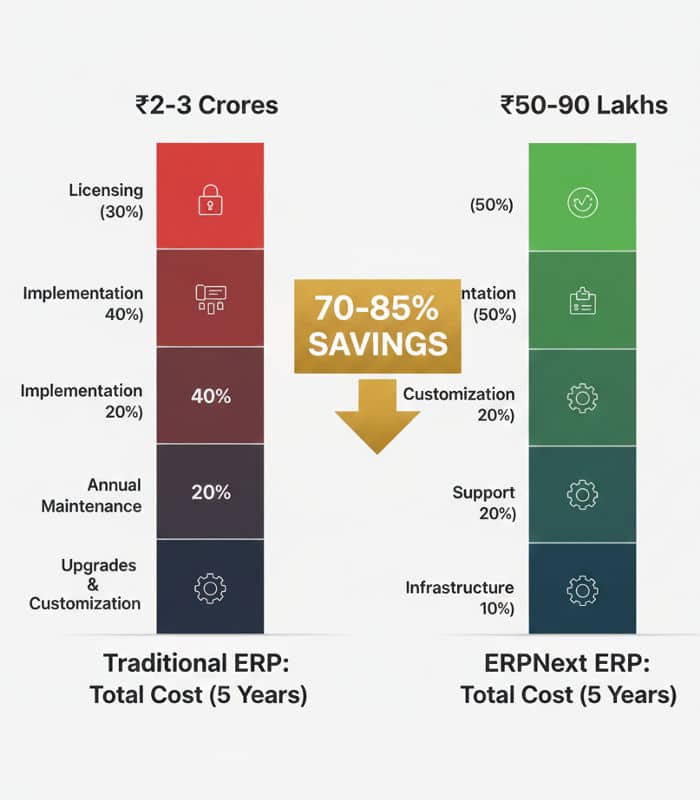
Let’s break down the real numbers. This ERPNext vs traditional ERP cost analysis is based on actual implementations for a typical 50-user Indian manufacturing business:
Traditional ERP (SAP Business One / Oracle NetSuite / Microsoft Dynamics):
Initial Costs:
- Software licensing: ₹50-75 lakh (₹1-1.5 lakh per user)
- Implementation services: ₹40-60 lakh (6-12 months project)
- Data migration: ₹8-12 lakh
- Training: ₹5-8 lakh
- Hardware/infrastructure: ₹10-15 lakh
Total Initial Investment: ₹1.13-1.70 crore
Annual Recurring Costs:
- Maintenance & support (18-22% of license): ₹10-15 lakh
- Mandatory upgrades (amortized): ₹6-8 lakh
- Consultant hours (50 days/year): ₹7.5-12.5 lakh
- Additional user licenses: ₹3-5 lakh
Annual Cost: ₹26.5-40.5 lakh
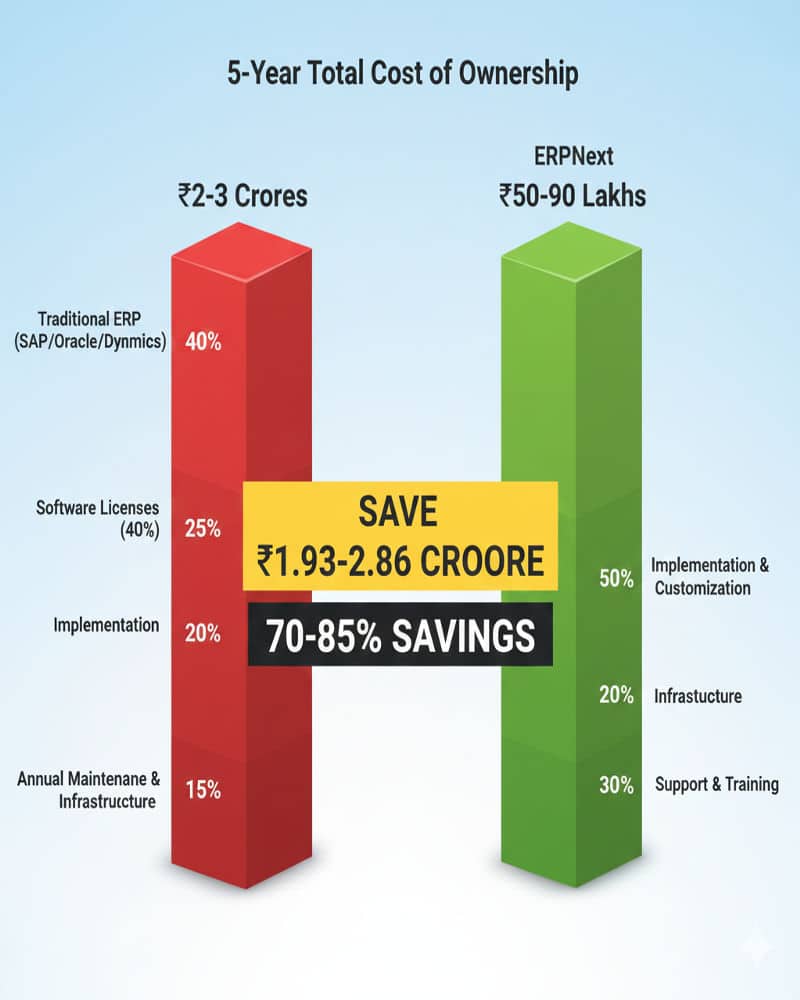
5-Year Total Cost of Ownership: ₹2.46-3.73 crore
ERPNext Open Source ERP:
Initial Costs:
- Software licensing: ₹0 (genuinely free, forever)
- Implementation services: ₹15-25 lakh (3-6 months project)
- Data migration: ₹3-5 lakh
- Training: ₹2-3 lakh
- Cloud hosting setup: ₹1-2 lakh
Total Initial Investment: ₹21-35 lakh
Annual Recurring Costs:
- Cloud hosting (dedicated server): ₹1.5-2.5 lakh
- AMC/Support contract: ₹3-5 lakh
- Minor customizations/enhancements: ₹2-3 lakh
- Additional users: ₹0 (unlimited)
Annual Cost: ₹6.5-10.5 lakh
5-Year Total Cost of Ownership: ₹53.5-87.5 lakh
The Real Savings: 70-85% Over 5 Years
The ERPNext vs traditional ERP cost difference is staggering: ₹1.93-2.86 crore saved over 5 years. That’s not marketing hyperbole—that’s based on actual implementation costs across dozens of Indian SMEs.
What could your business do with an extra ₹2 crore over 5 years?
- Expand manufacturing capacity
- Enter new markets
- Hire 15-20 additional team members
- Invest in R&D and product innovation
- Build working capital reserves
Feature Comparison: ERPNext Holds Its Own Against Giants
Manufacturing & Inventory Management
The ERPNext vs traditional ERP feature comparison in manufacturing reveals surprising parity:
ERPNext Offers:
- Multi-level bill of materials (BOM) with unlimited nesting
- Production planning with material requirement planning (MRP)
- Work order management with real-time tracking
- Quality inspection at multiple stages
- Batch and serial number tracking
- Multi-warehouse inventory with inter-warehouse transfers
- Subcontracting management
- Scrap management and material consumption tracking
How It Compares: ERPNext provides 80-90% of manufacturing functionality that companies actually use in SAP or Oracle, without the complexity and cost. Yes, SAP has more advanced planning algorithms and industry-specific features—but do you need production scheduling for semiconductor manufacturing? Most Indian SMEs don’t.
Financial Accounting & Indian Compliance
Complete GST Compliance:
- GSTR-1, GSTR-3B automatic generation
- E-way bill integration
- E-invoice generation
- TDS, TCS calculations and reporting
- Form 26AS reconciliation
Advanced Accounting Features:
- Multi-currency with real-time exchange rates
- Multi-company consolidation
- Cost center and profit center accounting
- Budget control and variance analysis
- Fixed asset management with depreciation
- Bank reconciliation with statement import
Integration with Indian Systems:
- GST portal API integration
- Payment gateways (Razorpay, PayU, Paytm)
- Banking APIs for major Indian banks
- Income tax portal integration
ERPNext is built with Indian regulations in mind, with updates for tax changes released faster than traditional ERP vendors who treat India as a secondary market.
CRM, Sales & Project Management
ERPNext vs traditional ERP extends beyond backend operations:
Customer Relationship Management:
- Lead capture from website, email, and social media
- Opportunity tracking with sales pipeline visualization
- Quotation and proposal generation
- Customer portal for order tracking
- Email integration and automated follow-ups
Project Management:
- Project costing and profitability tracking
- Timesheet management with billable hours
- Task assignment and progress tracking
- Gantt charts and project timelines
- Expense claims against projects
Sales Operations:
- Sales order management with multiple approval stages
- Credit limit enforcement
- Sales analytics and territory management
- Commission calculation for sales teams
- Customer loyalty programs and discounts
According to Gartner’s research on ERP systems, modern SMEs need integrated solutions that traditional vendors often split across multiple expensive modules.
When ERPNext is the Right Choice (And When It’s Not)
ERPNext Wins For:
- Revenue Range: ₹5-100 Crore: The sweet spot where you need ERP sophistication but can’t justify traditional ERP costs. Below ₹5 crore, you might be fine with accounting software. Above ₹100 crore, you might need enterprise-grade features.
- Manufacturing & Distribution Businesses: If you manage inventory, production, or distribution channels, ERPNext provides everything you need without the bloat of traditional systems designed for Fortune 500 companies.
- Customization-Heavy Requirements: Unique business processes, industry-specific workflows, or regional operational variations? ERPNext’s flexibility lets you adapt the system instead of adapting your business.
- Vendor Lock-In Fatigue: Tired of being held hostage by your current ERP vendor? ERPNext gives you complete independence—switch implementation partners, hire internal developers, or manage it yourself.
- Multi-Location Operations Across India: Managing warehouses in Mumbai, manufacturing in Gujarat, and sales offices across India? ERPNext handles multi-location complexity without per-location licensing fees.
- In-House IT Teams or Tech-Savvy Management: If you have technical resources or leadership that values control over convenience, ERPNext’s open architecture is a strategic advantage.